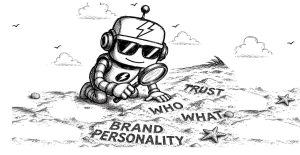
There is a famous saying: “Be yourself; everyone else is already taken.”
For people, it sounds like life advice.
For brands, it has become AI visibility work.
At WeDoSEO boutique, visibility starts with a simple question: can AI recognize your brand in a crowded conversation, or does it place you inside the same generic bucket as everyone else?
Search has changed. Your audience still reads, compares, asks, and decides. AI now joins that process. It looks at brand signals, connects meaning, and tries to understand who belongs in which answer.
That is why brand personality matters.
Because in AI search, personality is how your brand becomes recognizable.
TL;DR
- Define the pattern AI should recognize: Brand personality in AI search is the repeated pattern of what your brand says, does, supports, avoids, and invests in.
- Connect words, actions, proof, and context: A clear formula helps AI understand your brand faster: words + actions + proof + context = recognizable brand meaning.
- Choose 3–5 ideas your brand should own: Strong AI visibility starts when your brand repeats the same core ideas across content, actions, partners, and proof.
- Make every signal support the same story: Conferences, certifications, customer experience, LinkedIn, YouTube, mentions, and website content should all help AI understand where your brand belongs.
- Audit the gaps before AI fills them badly: When the pattern is weak, AI may connect your competitors to the answer before it understands why your brand should be there.
What Brand Personality Really Means
Personality is the pattern that makes someone recognizable.
A person has personality through what they care about, what they repeat, how they explain things, how they react, what they choose, and what they act on.
A brand works the same way.
Your brand personality is the repeated pattern that makes your brand feel specific.
It is what your brand cares about.
It is the conversations your brand enters.
It is the ideas your brand repeats.
It is the problems your brand keeps solving.
It is the actions your brand takes.
It is the boundaries your brand keeps.
For years, many companies treated brand personality as a tone-of-voice exercise.
Friendly.
Bold.
Professional.
Smart.
Human.
These words can help a team write better copy, yet they are too thin for AI search.
AI needs signals.
That means brand personality now reaches beyond style and voice.
It includes what your brand acts on.
Which conferences do you show up at?
Which certifications do you invest in?
Who do you partner with?
What customer problems do you keep solving?
What topics do you keep publishing about?
What do you support?
What do you choose to stay away from?
Those choices create a pattern.
That pattern is what AI can recognize.
Why AI Needs Brand Personality
People can take time to investigate a brand.
They can read your website, follow your LinkedIn posts, watch your founder speak, talk to your team, ask customers, compare case studies, and slowly connect the dots.
AI works with a shorter window.
It gets limited context.
It gets a few signals.
It gets a small amount of information to process.
It needs to understand what your brand is about quickly.
That is where brand personality becomes useful.
A clear personality gives AI a faster way to understand who you are, what you care about, what you solve, and where you belong.
Your team may know your brand perfectly.
Your best customers may understand your value after a sales call.
Your founder may carry the clearest version of the story in their head.
AI reads the signals that exist outside your team.
It connects the meaning that appears across your content, mentions, profiles, partners, conferences, certifications, reviews, and public activity.
So the real question is simple:
Does the visible pattern around your brand make you easy to understand?
The Crowded Conversation Problem
Most markets are crowded conversations.
B2B brands use the same category words, SaaS companies make similar promises while startups describe themselves with the same “faster,” “smarter,” “scalable,” and “data-driven” language.
AI sees that repetition everywhere and the result is category noise.
When many brands sound similar, AI needs stronger signals to understand what makes one brand different from another.
This becomes even harder in competitive markets.
Known players already have history, mentions, content and authority signals. They already sit inside the old conversations AI has learned from.
For a VP Marketing, Head of Growth, or founder entering a competitive space, this creates a real business problem.
Your brand may have a strong product.
Your team may have a clear point of view.
Your website may explain the offer.
AI may still connect the market conversation to better-known competitors because their signals are easier to recognize.
A growing brand needs a clearer pattern to enter that conversation and this is exactly where “Personality” comes in.
Your brand personlaity gives AI a set of meanings to connect:
This is what the brand talks about.
This is what the brand acts on.
This is the audience it serves.
This is the problem it keeps solving.
This is the proof that supports the story.
In a crowded conversation, personality is how AI knows it is you.
Brand Personality Is Built Through Words, Actions, Proof, and Context
A brand personality AI can recognize is built from four layers:
Words, actions, proof and context.
Words are the things your brand says.
Your website copy.
Your blog topics.
Your LinkedIn posts.
Your YouTube content.
Your founder content.
Your product pages.
Your thought leadership.
Words matter because they tell AI what topics and problems sit close to your brand name.
Actions are the visible choices your brand makes.
The conferences you attend.
The certifications you invest in.
The partnerships you build.
The communities you support.
The customer problems you prioritize.
The product decisions you make.
The topics you keep returning to.
Actions matter because they show AI what your brand actually cares about.
Proof is the outside evidence that supports your story.
Mentions.
Reviews.
Testimonials.
Backlinks.
Citations.
Partner pages.
Customer stories.
Industry references.
Proof matters because AI looks for repeated meaning across sources.
Context is what glues everything together.
A certification becomes stronger when it connects to your brand promise.
A conference becomes stronger when it connects to the market conversation you want to enter.
A partnership becomes stronger when it supports the authority you want to build.
A blog topic becomes stronger when it answers the questions your audience actually asks.
Without context, signals stay scattered.
With context, signals become meaning.
That meaning is what AI can understand.
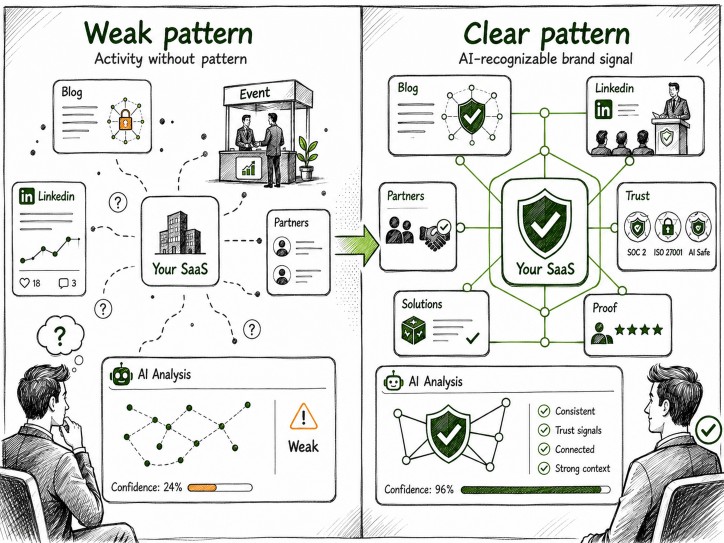
A Practical Example: From Random Signals to AI-Recognizable Meaning
Imagine a B2B SaaS brand that wants to be known for AI security.
The brand publishes one blog about AI security, sponsors one unrelated event, posts mostly generic growth tips on LinkedIn, and has partner pages that say very little about security.
To a person, the connection may become clear after a few meetings.
To AI, the pattern is weak.
Now imagine the same brand builds a clearer pattern.
Its blog answers AI security questions from buyers.
Its LinkedIn content repeats a sharp point of view about safe AI adoption.
Its conference talks focus on AI risk.
Its certifications support trust.
Its partner pages mention the same security use cases.
Its customer stories show the same problem being solved.
Now AI has more than one signal.
It has a pattern.
That is the difference between activity and AI-recognizable personality.
Why Style and Voice Are Too Small on Their Own
Style and voice still matter.
A clear voice helps people feel your brand.
A consistent style helps your content feel familiar.
A recognizable tone helps your team write with more confidence.
AI search adds another layer.
Your brand voice needs support from your brand behavior.
A brand that cares about education should teach.
A brand that claims expertise should show expert thinking.
A brand that wants to lead a market conversation should appear in that market.
A brand that wants trust should create visible trust signals.
That is why personality needs action. AI looks for repeated meaning. It connects what you say with where you show up, who mentions you, what topics surround you, and what proof supports you.
If your brand says one thing and acts around something else, the pattern becomes weaker.
If your brand repeats the same meaning through content, partnerships, public activity, customer experience, and authority signals, the pattern becomes easier to recognize.
How Brand Personality Supports GEO and AI Retrieval
GEO is about helping your brand become easier for AI systems to retrieve, understand, and use in answers.
Brand personality supports that work because it strengthens the meaning around your brand.
AI retrieval is rarely based on one page. It depends on connected signals, topics, entities, sources, mentions, authority, context, repetition.
When your brand personality is clear, AI has an easier time connecting your brand to the right audience questions. For example:
If your brand keeps publishing about AI visibility, appears in AI search conversations, builds authority around GEO, and repeats the same core language across platforms, AI has more reasons to connect your brand to AI search visibility.
If your brand talks about ten unrelated topics, shows up in random conversations, and uses different positioning everywhere, the retrieval path becomes weaker.
This is why brand personality is part of AI visibility.
It helps AI understand the relationship between your brand, the problem, the audience, and the answer.
What Happens When the Pattern Is Weak
A weak pattern does not always mean a weak brand.
Many strong companies look unclear from the outside: The product may solve a real problem, the team may have deep expertise, the customers may love the work, the founder may have a sharp point of view.
AI still needs visible signals to understand all of that.
When the pattern is weak, AI may struggle to understand what category your brand belongs to, which problems your brand solves, which audience your brand serves, which topics your brand should connect to and why your brand should be trusted.
That is how a brand becomes the weird uncle of the market – the one everyone sees at the family reunion, the one everyone knows exists yet no one really knows what he is about.
Present, but unclear.
And AI does not recommend unclear.
How to Define a Brand Personality AI Can Recognize
Start with the pattern.
Skip the generic adjectives.
A useful brand personality for AI search should answer practical questions.
- What do we want to be known for?
Choose 3–5 ideas your brand should own.
These ideas should connect to your offer, your audience, your expertise, and the problems you want to be part of. - What words should stay close to our brand name?
Think in semantic clusters.
Which topics, phrases, problems, and category terms should AI connect to your brand?
This is where SEO, GEO, and brand strategy meet. - What conversations should we enter?
Your brand needs the right conversations.
For some brands, that means AI search.
For others, it means technical SEO, product education, market entry, customer experience, content strategy, or category leadership.
The right conversation is the one your audience already cares about and your brand has a real reason to join. - What actions support the story?
List the proof behind your personality.
Conferences.
Certifications.
Partnerships.
Content formats.
Customer experience.
Product decisions.
Community activity.
Team expertise.
If the actions support the message, the brand becomes easier to believe. - What should we stay away from?
Boundaries are part of personality.
A brand becomes clearer when it knows what it wants to be known for and what it wants to avoid.
This helps AI understand the edge of your meaning. - Where is the pattern broken?
Audit the places AI may use to understand your brand.
Website.
LinkedIn.
YouTube.
Founder profiles.
Third-party mentions.
Partner pages.
Reviews.
Podcasts.
Directories.
Conference bios.
If every signal points in a different direction, the brand becomes harder to understand.
A Quick AI Visibility Audit for Brand Personality
Use this simple audit before creating more content:
Can we explain our brand personality in one sentence?
Do we have 3–5 ideas we want AI to connect to our brand?
Do our website, LinkedIn, YouTube, and third-party mentions repeat the same meaning?
Do our conferences, certifications, partners, and public actions support the same story?
Do our reviews, testimonials, and references prove the same positioning?
Do we know which conversations we want to enter?
Do we know which conversations we should avoid?
Can AI understand why our brand belongs in the answer?
If the answer is unclear, more content will create more noise.
The work starts with the pattern.
The Role of Context in AI Visibility
Context is the difference between activity and authority.
A company can publish blogs, attend events, earn mentions, build partnerships, and invest in certifications.
Those actions help AI visibility when they connect to one clear story.
Context explains why the brand belongs in the conversation.
It connects the brand’s actions to the brand’s position.
It turns separate signals into a recognizable pattern.
For AI, this matters because retrieval depends on meaning.
AI systems need to understand the relationship between your brand, the topic, the problem, the audience, and the proof.
The clearer the relationship, the easier it becomes for AI to connect your brand to the right answer.
Where WeDoSEO Comes In
This is where strategy becomes practical.
A brand personality for AI search is built by connecting words, actions, proof, and context into one clear pattern.
At WeDoSEO boutique, we help brands make that pattern visible.
First, we define what the brand should be known for.
Then we identify the words, topics, and ideas that should stay close to the brand name.
Next, we map the conversations the brand should enter and the conversations it should avoid.
Then we review whether the brand’s website, LinkedIn, YouTube, mentions, partners, and public actions tell the same story.
We look for the gaps between what the brand thinks it says and what AI can actually understand.
From there, we build the content, SEO, GEO, and authority strategy that helps AI connect the brand to the right audience questions.
This work brings together AI visibility, semantic clustering, content strategy, cross-platform consistency, technical SEO, and authority building.
The goal is simple:
Make your brand easier to understand.
Easier to trust.
Easier to retrieve.
Easier to cite.
Easier to recommend.