“We Didn’t Budget for SEO this Year"
We hear this sentence a lot in recent conversations, and it usually comes from a place that makes sense. AI can now write content, summarize pages, compare products, create outlines, draft posts, and help marketing teams move faster than they could before. Because of that, many brands started looking at SEO as something from the old marketing world, as if the basic work behind search visibility had already been solved.
For some teams, SEO now feels like tags, sitemaps, technical fixes, headings, page structure, content optimization, keyword lists, internal links, schema, and all the other work that lived behind the scenes for years. It can feel like a checklist from the old search world, especially when the new search experience is happening inside ChatGPT, Gemini, Perplexity, Google AI Overviews, and other AI answer engines.
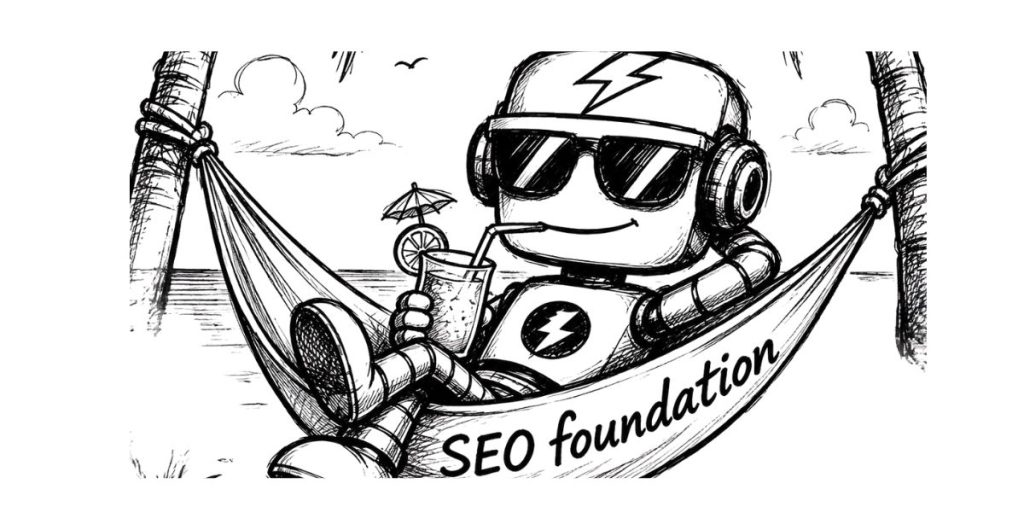
Here is the friendly reminder: the new conversations are still being built on top of that old foundation. AI search may feel new, and the way people search, compare, and decide has changed, yet AI still needs something solid to build the answer from. It still needs to understand your website, your category, your pages, your offer, your audience, and the signals that connect your company to a specific problem. That is why SEO is still kicking.
- SEO is still relevant in the age of AI search because AI systems still need clear language, structure, consistency, and authority before they can understand and include a brand.
- Keywords did not disappear. The language around them changed, and today they show up as semantic signals, topic clusters, category language, and entity connections.
- Technical SEO, page structure, internal links, schema, and content architecture still help search engines and AI systems understand what your website is about.
- Brand consistency across your website, LinkedIn, YouTube, social platforms, and third-party sources helps AI connect the same meaning across different places.
- Authority is becoming even more important because AI needs reasons to trust, cite, recommend, and bring a brand into the right answer.
The Search Experience Changed, yet the Foundation is Still Here
The way people discover brands is changing quickly. A buyer may start with a question inside ChatGPT, compare options through Perplexity, see a Google AI Overview, watch a YouTube video, check LinkedIn, and only then visit a website. The journey is no longer built around one search box and ten blue links, which means visibility now has to work across more places, more formats, and more types of answers.
At the same time, the basic challenge did not disappear. Before people can choose you, they need to understand you. Before AI can include you, it needs to understand you too. That understanding comes from the same foundation SEO has always worked with: clear language, strong structure, technical access, useful content, authority signals, and a consistent brand story. The names have changed.
We now talk about AI visibility, GEO, semantic optimization, entity understanding, AI retrieval, answer visibility, and AI search strategy. These names describe real changes in how search works, and they also point back to the same core idea: your brand needs to be understandable enough to be found, trusted, and shared.
Yes, You Still Need Keywords
Let’s say it simply. You still need keywords, even when you do not call them keywords anymore.
Today, the work is less about repeating one exact phrase and more about building the language system around your brand.
AI needs repeated patterns to understand what category you belong to, what problem you solve, who you help, what your product is connected to, and which questions should bring your brand into the conversation.
This is why keyword work is still alive, even if the old version of keyword work feels outdated. In the age of AI search, keywords become category signals, topic clusters, entity relationships, buyer questions, comparison terms, use-case language, and human pain points.
The goal is to create a language base that helps AI understand where your brand belongs.
For example, a company cannot describe itself as an automation platform on the homepage, a workflow tool on LinkedIn, an AI assistant in blog content, and an operations solution in external profiles, then expect AI to connect everything into one strong meaning.
All of those descriptions may be connected, yet the brand still needs a clear center. This is where SEO becomes more strategic.
The job is to understand which words your audience uses, which words AI already connects to the category, which words competitors are owning, and which words your brand needs to repeat naturally across the website and external sources. That is not keyword stuffing. That is building meaning.
Consistency Helps AI Understand Brands
AI does not understand your brand from one page alone. It connects signals from many places / sources, including your homepage, product pages, service pages, blog, LinkedIn page, YouTube content, social profiles, founder profiles, partner pages, directories, reviews, media mentions, and third-party references.
When these places tell different stories, AI gets mixed signals. One page may say the company is a content agency, another may say it is an SEO agency, another may say it is an AI visibility partner, and another may describe it as a technical SEO team. This can happen naturally as a company grows, adds services, enters new markets, or changes its positioning, yet AI still needs a stable meaning to work with.
Consistency does not mean saying the exact same sentence everywhere. It means creating a clear pattern around what the company does, who it helps, what category it belongs to, what problems it solves, and why it should be trusted. When the same meaning appears across the website and external sources, AI has a stronger base for understanding the brand.
This is why brand consistency has become part of SEO and GEO work. It is also why the website cannot carry the whole story alone. If the website says one thing and the wider web says another, AI will try to connect the signals it finds. The stronger and more consistent the signals are, the easier it becomes for AI to understand what your brand should be known for.
Structure Still Does a lot of Heavy Lifting
AI can create content fast, but fast content does not automatically create a strong website. A brand can publish many articles and still fail to build a content system that explains the business clearly. A website can have hundreds of pages and still fail to show which page answers which question, which page supports which service, and which page should be trusted as the main source.
This is why structure still matters in the age of AI search. Search engines and AI systems need pages they can access, parse, and understand. Users also need pages that help them move from question to answer without confusion. Page hierarchy helps show which topics are central. Headings help explain what each section covers. Internal links help connect related ideas and pages. URLs help organize content. Schema helps label important information. Sitemaps help search engines discover important pages. Technical health helps crawlers access and process the website. Content architecture helps connect category, pain, solution, proof, and business value.
This is the part many companies underestimate when they rely too heavily on AI content production. AI can help create text, but someone still needs to decide where that content belongs, what role each page plays, how the pages support each other, and how the full website explains the brand. Without that structure, content becomes a pile of pages. With structure, content becomes a map.
Authority gives AI a Reason to Trust You
AI search is not looking only for information. It is trying to provide an answer that feels useful, reliable, and connected to trusted sources. This is where authority becomes a major part of the foundation.
Authority can come from expert content, strong author profiles, original insights, customer stories, case studies, testimonials, awards, certifications, industry references, partner pages, backlinks, media mentions, social proof, and repeated brand signals across trusted sources. It can also come from how clearly the brand connects to a category and how strongly external sources support that connection.
Many brands already have authority in real life, but that authority is not always visible online. Their strongest knowledge may live inside sales calls, customer meetings, internal decks, technical documents, old PDFs, or founder conversations. The company may have real expertise, strong customers, and years of experience, yet AI cannot use signals it cannot find or connect.
This is where SEO and authority work meet. The goal is to make expertise visible, searchable, understandable, and connected across the places AI and humans use to evaluate a brand. If your brand wants to be included in AI answers, it needs more than content. It needs a reason to be trusted.
The old SEO Checklist has a New Job
The old SEO checklist is still useful, although its role has changed. It now supports AI visibility, brand understanding, retrieval, and answer inclusion alongside traditional search visibility.
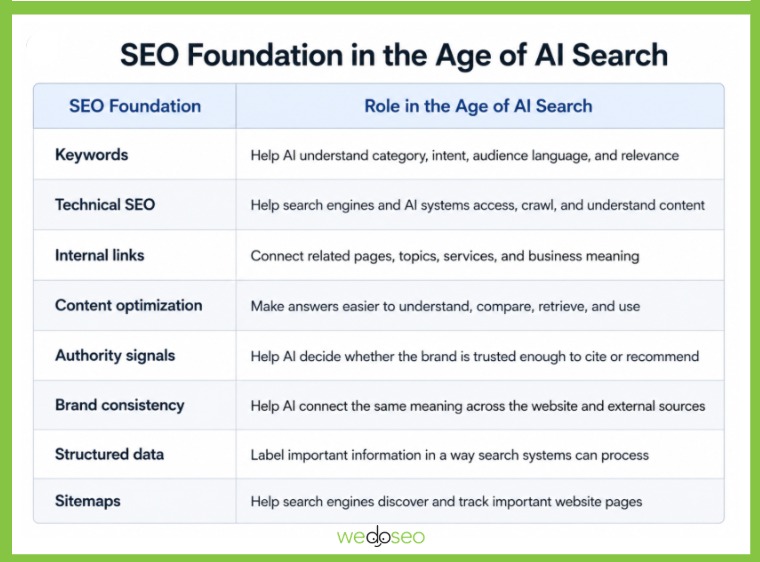
This is why SEO keeps showing up in every serious conversation about AI search. The work is changing, the channels are changing, and the language is changing, yet the need for a strong foundation continues.
AI visibility Needs Human Strategy
AI can help teams move faster, and that is a real advantage. It can support research, draft outlines, summarize sources, create briefs, group topics, and help teams produce content at a speed that was hard to imagine a few years ago.
Still, speed does not replace strategy.
Someone needs to decide what the brand should be known for. Someone needs to understand the market conversation and decide which part of it the brand should enter. Someone needs to connect customer pain, product value, category language, search demand, AI retrieval, technical structure, and business growth. Someone also needs to look at the foundation and ask whether it is strong enough for what the company is trying to build on top of it.
Are the pages clear enough? Is the website structured well enough? Is the brand language consistent enough? Is the category connection strong enough? Are there enough authority signals? Are competitors already more trusted by AI? Are there gaps the brand can enter?
This is what optimization means now. It is continuous attention to how the brand is understood by people, search engines, and AI systems.
A Simple Formula for AI Visibility
AI Visibility Foundation = Language Consistency + Content Structure + Technical Access + Authority Signals + Business Relevance.
This formula is simple, but it explains why SEO is still part of the AI search conversation.
Language consistency helps AI understand what the brand is connected to. Content structure helps AI understand what each page is supposed to answer. Technical access helps search systems crawl, index, and process the website. Authority signals help AI decide whether the brand can be trusted. Business relevance keeps the strategy connected to qualified leads, revenue, and real decisions.
When one part is weak, the full foundation becomes weaker. A brand can have strong content with poor technical access, strong authority with unclear positioning, strong keywords with weak business connection, or strong structure with a story that does not match how the market talks.
AI visibility improves when the parts work together.
The Real Risk of Skipping SEO in the AI era
When a company says, “We didn’t budget for SEO this year,” the real conversation is bigger than SEO. It is about whether the brand is ready to be understood in the new search environment. It is about whether the website explains the business clearly, whether the content connects to the questions buyers are asking, whether AI systems can understand the category and product, whether the brand has enough authority to be trusted, and whether the same meaning appears across the website, social platforms, and external sources.
The risk is simple.
If AI cannot understand your brand, it has no strong reason to include your brand in the answer. If your brand is missing from the answer, your buyer may never reach the page where your strongest message lives. This is why SEO is still kicking in the age of AI search. The old world was never really old. It was the foundation, and foundations need constant attention.
How WeDoSEO Helps
WeDoSEO helps brands build AI visibility strategies that connect SEO, GEO, content structure, technical readiness, brand language, and authority into one system.
We look at how your brand is presented on your website, how it appears across external sources, how AI understands your market, which competitors are already trusted, and which conversations your brand needs to enter.
Then we build the strategy, content, structure, and authority signals that help your brand become found, understood, and trusted across humans and AI. If your company did not budget for SEO this year, this is the right time to ask a bigger question:
Is your foundation ready for AI search? Let’s talk.